

When I find myself teaching tasting techniques to my clients or students, I often suggest the game of personalizing the wine. That is, I ask them to imagine a person who has the character of the wine they are tasting and to describe their physical and personality traits. Personifying a wine helps to remember it better and to judge it more calmly, without all the seriousness and authority associated with the world of sommeliers.
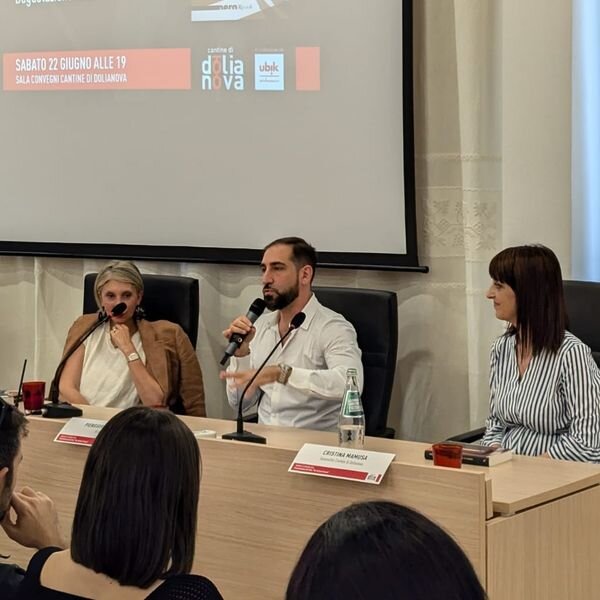
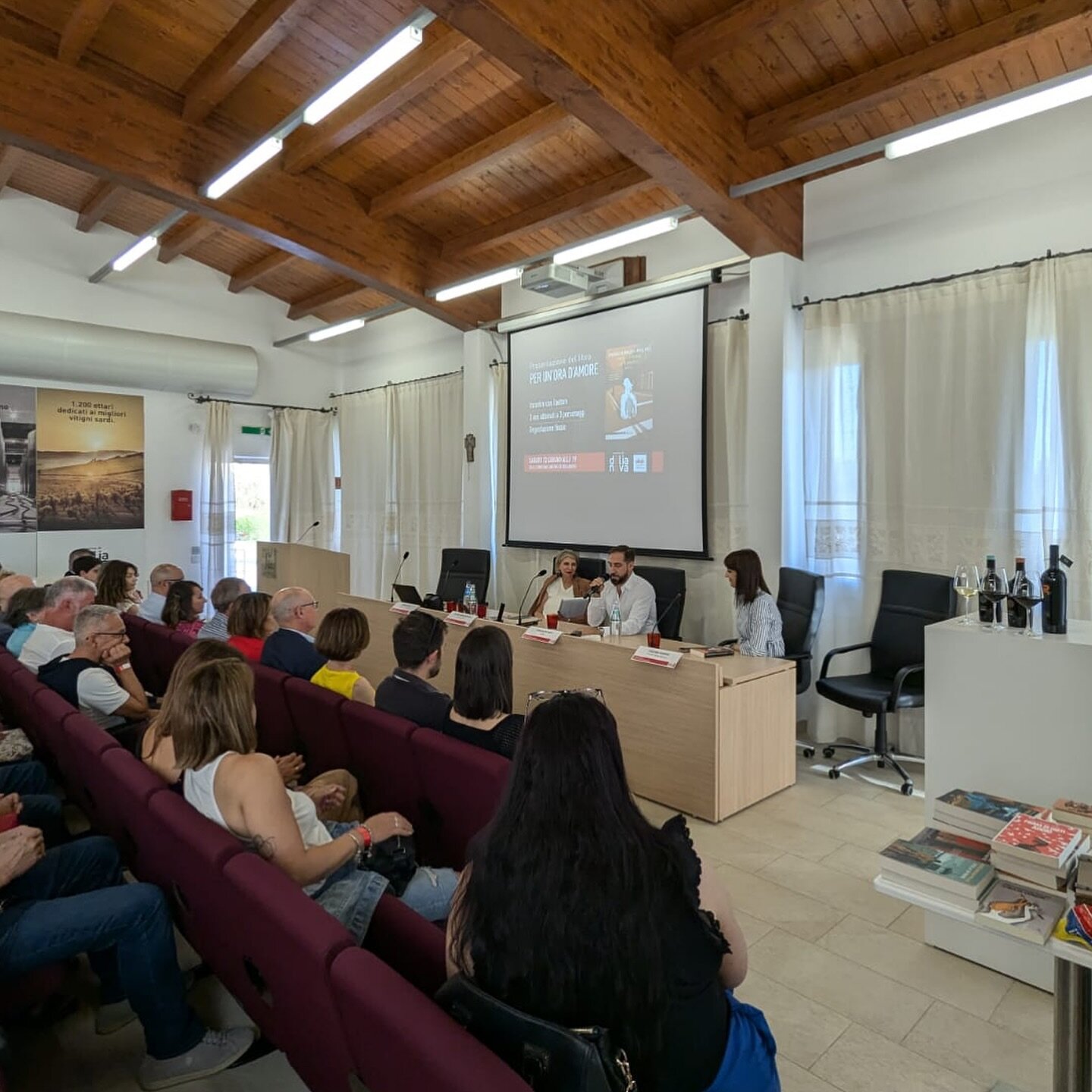
During the event on June 22, we played with the characters from PER UN’ORA D’AMORE who struck me the most and those of the wines from @cantinedolianova trying to find the similarities that unite them
During the event on June 22, we played with the characters from PER UN’ORA D’AMORE that struck me the most and those of the wines, trying to find the similarities that unite them https://www.cantinedidolianova.it/perunoradamoreincantina/
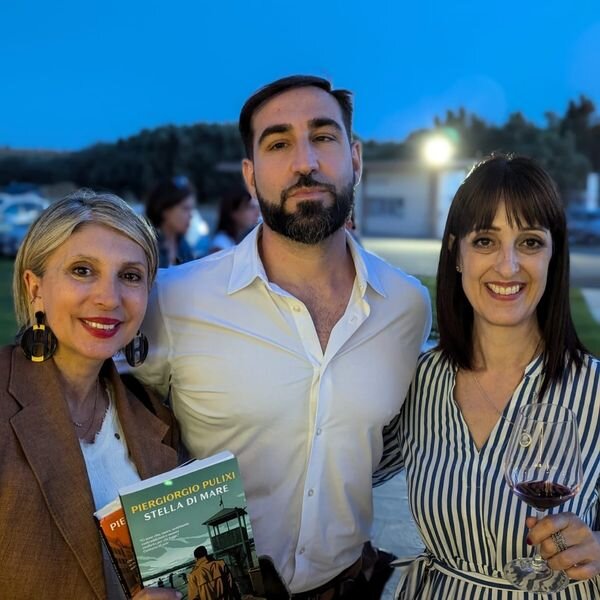
Thanks to @piergiorgiopulixi for accepting the invitation to take part in what turned out to be a perfect evening and to @claudiarabellinobecce who, with her questions, helped us discover the writer and the man
Thank you to for accepting the invitation to participate in what was a perfect evening and to who, with his questions, helped us discover the writer and the man

For those who missed them, here are the proposed pairings:
JU (ISOLA DEI NURAGHI IGT) – DEPUTY COMMISSIONER STREGA
The grape variety: Barbera Sarda & Syrah
Barbera Sarda: often confused with Barbera Piemontese, with which it shares some morphological and compositional characteristics, Barbera Sarda is an indigenous red grape variety, mainly found in the central-southern area of Sardinia. In various localities on the island it is known by different names, such as Bovali Mannu and Bovaleddu di Escalaplano. It is a grape variety that gives wines aromaticity, with floral and fruity notes.
Syrah is an international grape variety, probably of Middle Eastern origin, often used in blends with other varieties, and gives wines aromaticity, with floral, fruity and spicy notes (black pepper).
The combination of the two grape varieties gives rise to fruity, spicy, structured wines suitable for aging.
The wine: Ju
Color: intense, bright ruby red, tending towards garnet with aging.
Bouquet: on the nose it is intense, deep and structured. Dense scents of ripe cherry, spices and balsamic notes of Mediterranean scrub can be recognized.
Taste: generous and elegant body, aromas of ripe red fruit and licorice emerge, accompanied by sweet spices and refined tannins.
After crushing, the must macerates for about 12-14 days at a temperature of 26-28°C. After racking, the wine is transferred to vitrified cement tanks where it undergoes malolactic fermentation and then transferred to new barriques where it ages for 24 months. After this period, the wine is bottled and left to rest for another 6 months in a horizontal position before being available for sale.
A wine for long aging. Important food and wine pairings.
The character: Vito Strega
He is perhaps the most important and complex character in the book (just as Ju is the most important wine of the winery). He is the coordinator of the investigations and all the characters revolve around him. A brilliant investigator endowed with remarkable intuition, physically imposing and exotic due to the color of his skin. A fascinating man capable of seducing, but with demons to fight and dark sides hidden from everyone. He tends not to get emotionally involved in his private life, while the cases he works on involve him body and soul. Ju perfectly expresses his austere, somber but at the same time alluring, fascinating, fresh character. He has a long history behind him and an equally long one ahead, just like our wine, which is produced only in the best vintages. The spiciness of the Syrah recalls his exotic and intriguing side.
ARENADA (MONICA DI SARDEGNA DOC) – ITALO SEU
The grape variety: Monica
A grape variety that has not accustomed us to strong emotions but to certainties. Loved for its softness and low alcohol content. Present on our grandparents' tables to accompany daily meals.
Among the red grape varieties, Monica is, together with Cannonau, one of the most representative of Sardinian viticulture. Introduced to the island in ancient times, it is present throughout Sardinia and gives rise to two different DOCs: Monica di Sardegna and Cagliari Monica. Blended with Bovale Sardo and Cannonau, it is part of the DOC Mandrolisai.
The low level of acidity and high productivity have also led to Monica being used as a table grape. Although easy to harvest and with consistent and abundant yields, Monica is a grape variety that requires caution in the vineyard as the grape is subject to early ripening, which leads to wines with excessive alcohol levels. On the palate it is warm and pleasantly soft.
Monica is one of the oldest grape varieties introduced in Sardinia, present, albeit in different percentages, throughout the island, where it is cultivated on a total area of about 3,000 hectares. The most accredited hypothesis about its origins is that it was introduced to Sardinia around the 11th century by the Camaldolese monks, from whom the name by which it is most widely known is derived. Another theory attributes its origin to the period of Spanish domination; in fact, in some areas of the island the grape is called "Monica di Spagna" or "Uva Mora". The grape expresses its best productive potential on moderately deep, calcareous soils in hilly areas with medium slopes, well exposed to the sun.
The wine: Arenada
Color: ruby red with violet reflections, tending towards garnet with aging.
Bouquet: intense and persistent, ethereal, vinous, with hints of raspberry and cherry.
Taste: warm, suitably tannic, persistent, with a delicate herbaceous vein.
The grapes, after destemming and crushing, are sent to fermentation which lasts for 8-10 days at a temperature of 26°C. After racking, the wine is transferred to vitrified cement tanks where it undergoes malolactic fermentation. After an aging period of several months, it is bottled and marketed not before April 1st following the harvest.
It is suitable for aging 3-4 years from the harvest.
The character: Italo Seu
Mr. Seu could represent one of the typical members of the Winery.
“Italo Seu had started working in his father's vineyards when he was little more than a child, and the dampness of the soil, the wind, and the freezing cold of early mornings day after day had seeped into him, wearing him down, tormenting his awakenings, grinding his bones. Thinking back to the last harvests he had carried out almost alone, given the economic crisis that prevented him from hiring laborers and forced him to work on the verge of eighty.”
He is a person who fights to find out the truth about what happened to his daughter, therefore stubborn but gentle at the same time. He is a polite and reliable character with hands worn by work (one of the cornerstones of his life, like family). He takes care of his grandson by all possible means. He is someone you can count on, just as you can count on a good glass of Monica, always ready to be enjoyed at every meal, rustic but at the same time gentle.
PRENDAS (VERMENTINO DI SARDEGNA DOC) - INSPECTOR RAIS
The grape variety: Vermentino
Say Sardinia and you think Vermentino. The island is certainly one of the territories where this grape variety, which arrived in Gallura at the end of the 19th century and then spread throughout the island, expresses itself at its best, giving life to a white wine with a strong personality, very different from the wines of the same name that can be found in other Italian regions.
The wine: Prendas
Color: pale straw yellow, with light greenish reflections.
Aroma: intense floral, fresh and fruity.
Taste: intense and persistent, acidic, with a delicate and characteristic bitter vein on the finish.
After a careful selection of the most suitable plots, the grapes undergo destemming and crushing followed by gentle pressing. The resulting must is clarified by static cold decantation and the clean fraction is inoculated with selected yeasts. Fermentation is carried out at temperatures of 14-16°C for about fourteen days. Once fermentation is finished, the wine remains in contact with its noble lees for about 45 days and is bottled in the spring following the harvest to preserve its freshness characteristics intact.
The character: Inspector Mara Rais
In "Un’ora d’amore" Inspector Rais does not play a central role but is nonetheless decisive because her contribution leads to the resolution of the case. In this latest novel, only some aspects of her character are revealed, but those who have read the previous ones have a clear idea of what kind of woman she is. She is determined and professional in her work. She likes to dress elegantly or at least appear feminine (in contrast to Inspector Croce). She is often sarcastic and sharp but also energetic and passionate. The Prendas Vermentino is perfect to describe her character, because it is a winning wine (already awarded with several medals), fruity, fresh, mineral but with that bitter note on the finish.
.png "10 cibi sardi da assaggiare assolutamente a Cagliari")
.png "10 Sardinian Foods You Must Try in Cagliari")
.jpeg "San Benedetto Market Cagliari: The Complete Guide to Sardinia's Most Authentic Food Experience (2026)")