
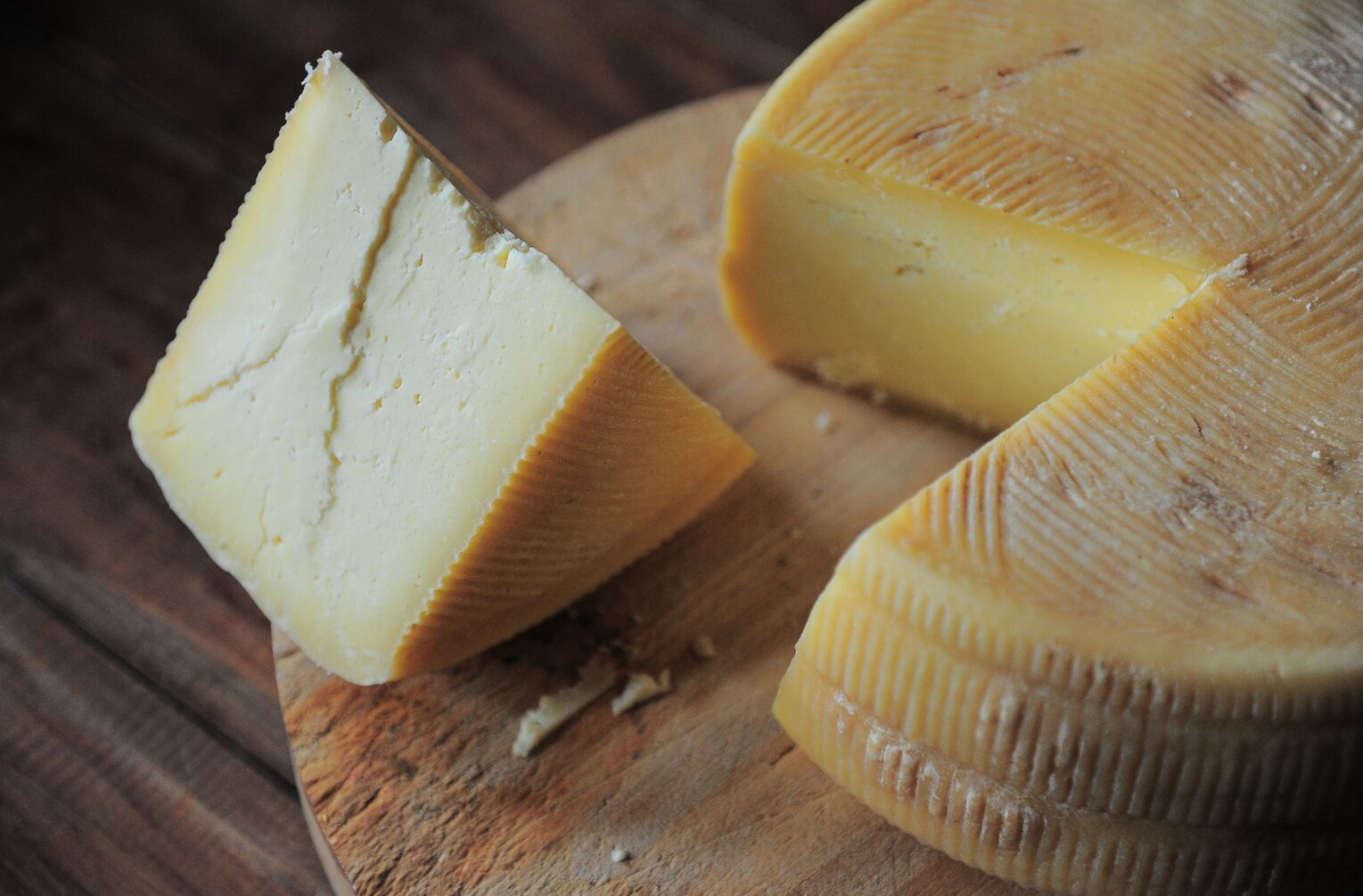
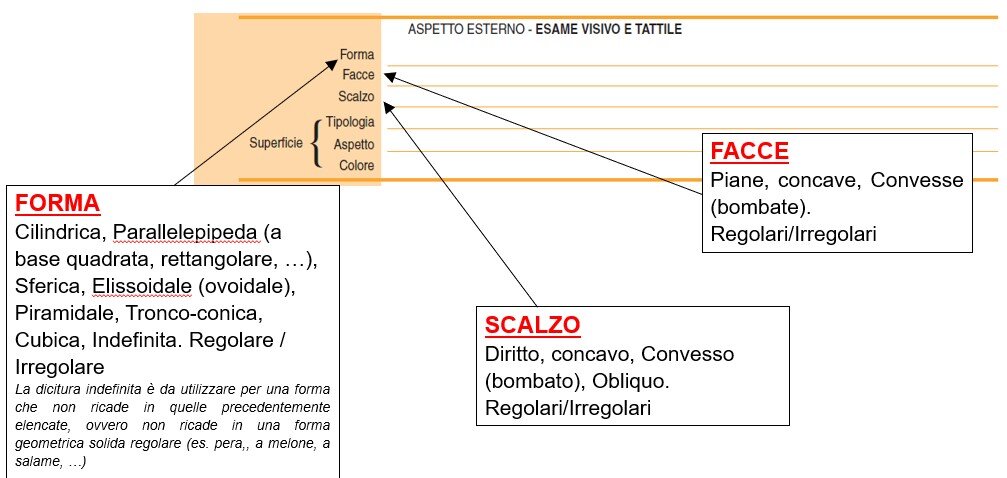
The sensory analysis of cheese, just like that of other products, requires concentration and discipline, because it is not a simple tasting but something more complex. It is something that involves all our senses and allows us to recognize and define the quality of the products tasted, transforming simple sensations into perceptions. This is the role of a cheese taster. First of all, the cheese is observed, starting from the external appearance of the wheel, trying to assign it a reference geometric shape. Next, the faces and the heel are evaluated, concluding with an examination of the surface. Through this external examination, the expert taster is already able to know how aging or maturation has influenced the characteristics of the cheese. The next step is to cut the wheel and examine the paste. First the color, in its shades and its uniformity or lack thereof, and then the under-rind. When a cheese presents at least five or six olfactory descriptors detected in detail and does not offer negative odors, it can be said to be of high quality. And then comes the gustatory part! With slow chewing of a small portion, the cheese is moistened and warmed, and the fundamental flavors are perceived by the taste buds over the entire surface of the tongue. During chewing, volatile substances are also released that reach the so-called retronasal pathways and allow us to perceive the aromas. To complete the gustatory examination, it is necessary to evaluate the "trigeminal" perceptions (transmitted by the trigeminal nerve) which are spicy, astringent, metallic, and refreshing. Finally, the physical-mechanical aspect of the paste in the mouth, also called structure, should not be forgotten. Before describing in detail all the phases of sensory analysis, let us remember that the name "formaggio" or "cacio" is reserved for the product obtained from whole MILK, or partially or totally skimmed, or from cream (of milk), following ACID or rennet COAGULATION, also using FERMENTS and table salt. For cheese as well, a TASTING SHEET is used, which allows to establish and standardize the parameters to be evaluated, the evaluation rules, the individual parameters, and the scale of values to be assigned to each parameter. For the tasting of cheeses and their analysis, we will use the method and descriptive sheet prepared by the ONAF (Organizzazione Nazionale Assaggiatori Formaggi). In this first phase, the following parameters must be analyzed: SHAPE (physical conformation of the cheese): cylindrical, parallelepiped (with square or rectangular base), spherical, ellipsoidal, pyramidal, truncated-conical, cubic, undefined. Regular/Irregular; FACES (the two horizontal surfaces of the wheel): flat, concave, convex. Regular/Irregular; HEEL (vertical surface or height or thickness of the wheel): straight, concave, convex (bulging), oblique. Regular/Irregular; SURFACE: skin, rind, and crust; APPEARANCE OF THE SURFACE; COLOR OF THE SURFACE.
The portioned cheese at this point is served to the taster, who for the first time comes into physical contact by taking it in hand to evaluate its structure. The following examination is the most engaging, namely the olfactory analysis.
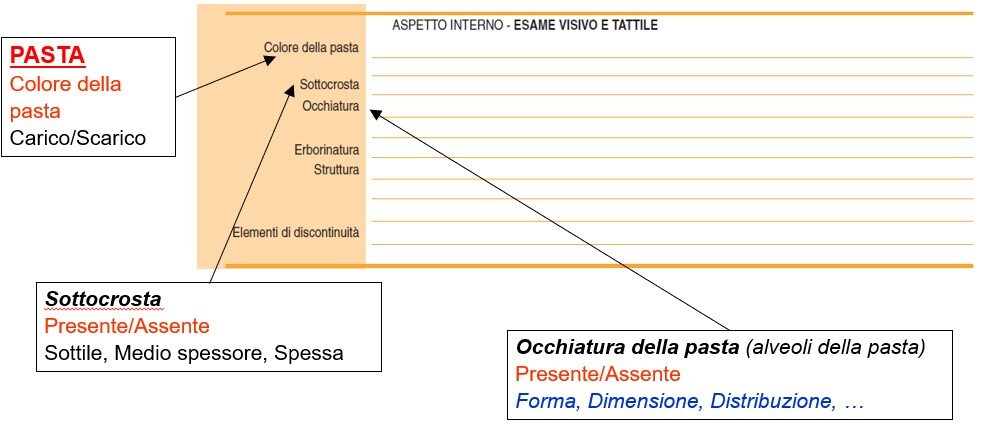
Next, the visual and tactile examination of the inside of the cheese is carried out after cutting a portion according to the rules provided for each type. The parameters to be analyzed at this stage are as follows: PASTE: color of the paste. Intense/Light; UNDERCRUST: present/absent, thin, medium thickness, thick; PASTE EYE FORMATION (paste holes): present/absent, shape, size, distribution; BLUEING (if present); PASTE STRUCTURE; DISCONTINUITY ELEMENTS IN THE PASTE.
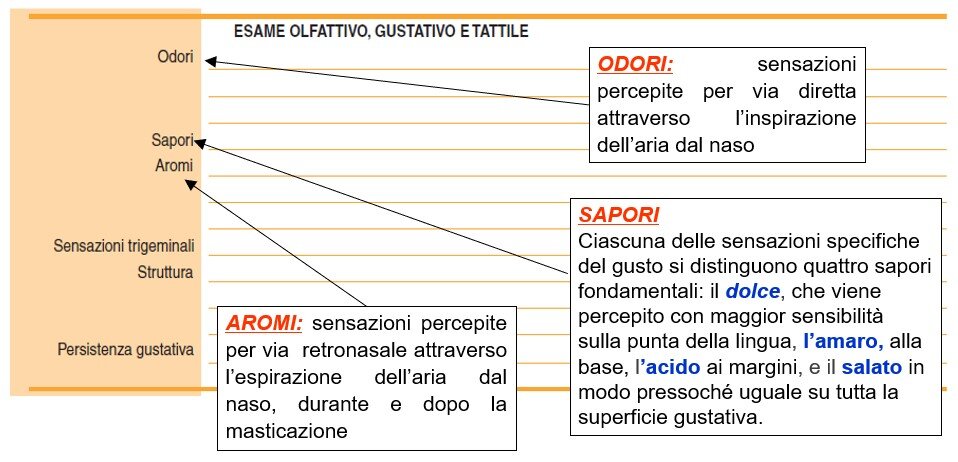
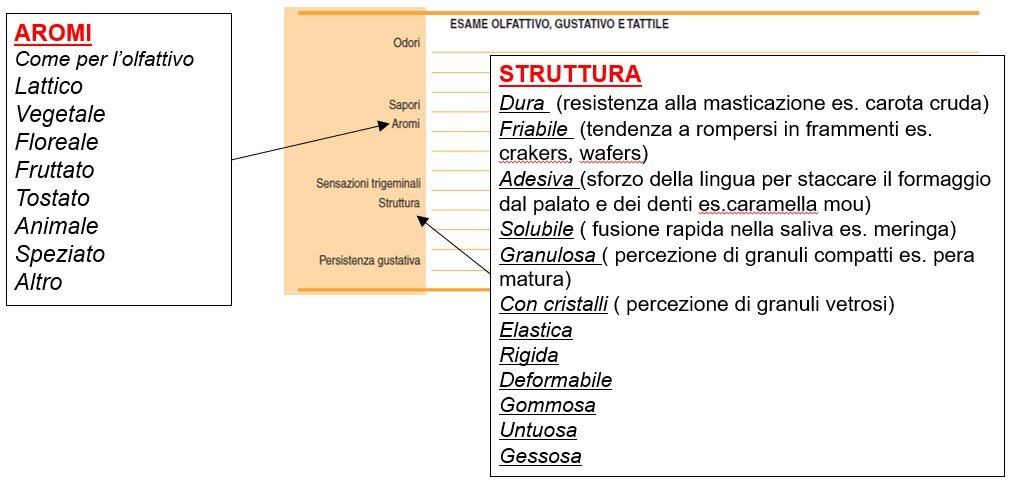
In the third phase of the analysis, the perception and coding of odors, flavors, and aromas takes place, without forgetting the tactile sensations experienced in the mouth during tasting. ODORS: sensations perceived directly through the inhalation of air through the nose; FLAVORS: there are four fundamental flavors: sweet, which is perceived with greater sensitivity at the tip of the tongue, bitter at the base, sour at the edges, and salty almost equally over the entire gustatory surface; AROMAS: sensations perceived retronasally through the exhalation of air from the nose, during and after chewing; TRIGEMINAL SENSATIONS: astringent (unripe cocoa, artichoke, tannin), spicy (pepper, chili pepper), pungent (ammonia, vinegar, mustard), refreshing (menthol), burning (alcohol), metallic (ferrous, blood).
In this phase, STRUCTURE and TASTE PERSISTENCE are also analyzed STRUCTURE: hard (resistance to chewing e.g. raw carrot), crumbly (tendency to break into fragments e.g. crackers, wafers), adhesive (effort of the tongue to detach cheese from the palate and teeth e.g. toffee), soluble (rapid melting in saliva e.g. meringue), grainy (perception of compact granules e.g. ripe pear), with crystals (perception of glassy granules), elastic, rigid, deformable, chewy, greasy, chalky. TASTE PERSISTENCE: Low (3 sec or less than 3), Medium-low (from 4 to 9 sec.), Medium (from 10 to 15 sec.), Medium-high (from 16 to 29 sec.), High (of 30 or more seconds).
Now you have all the elements to begin your first sensory analysis. All that's left is to choose your favorite cheese and try to give it a technical and objective evaluation, not just an emotional one. And remember, a good cheese never tires the palate but encourages anyone to taste a little more.
N.B. For the writing of this article, I collaborated with my friend Stefano Mazzella, technical taster, and used educational material from ONAF.
.png "10 cibi sardi da assaggiare assolutamente a Cagliari")
.png "10 Sardinian Foods You Must Try in Cagliari")
.jpeg "San Benedetto Market Cagliari: The Complete Guide to Sardinia's Most Authentic Food Experience (2026)")