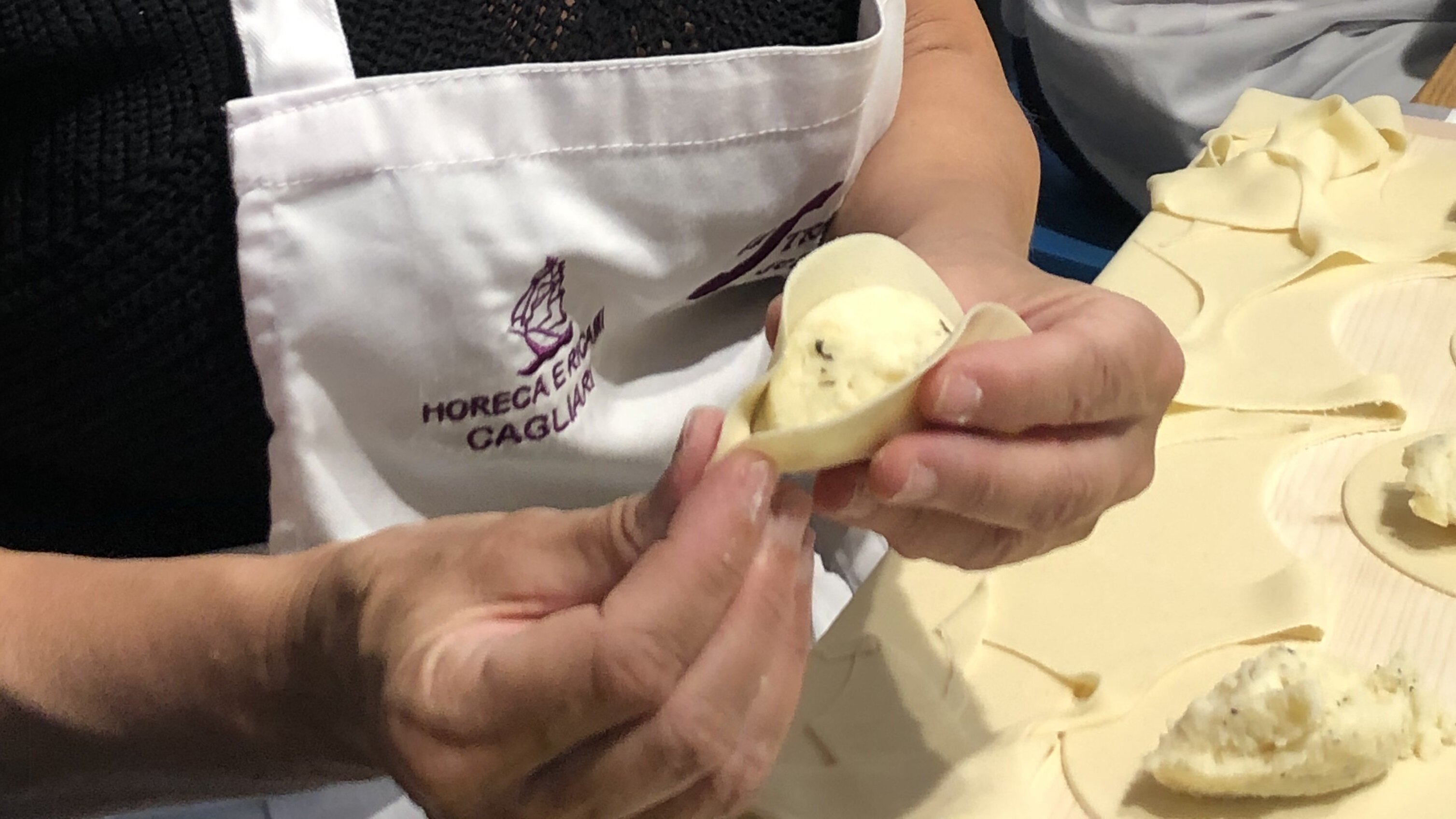
Finally, after the summer break, which saw us busy on other fronts, we are back to offer you our cooking classes dedicated to traditional Sardinian fresh pasta. In the new season, in addition to offering lessons to learn the techniques for making the most well-known pasta shapes, such as the beautiful Lorighittas, the ever-classic Malloreddus, Maccarrones de busa, Fregula, and Culurgiones ogliastrini, we would also like to focus on lesser-known shapes, in order to rediscover all our traditions. Among the pasta shapes to bring back to our kitchens are undoubtedly Catalufas Tzacarramanu, Caombasa, and Michitus Nieddus, for which I am providing a brief description taken from the list of Traditional Agri-Food Products (PAT) of the Sardinia Region. The Catalufas Tzacarramanu are a type of pasta traditionally produced in the municipality of Sardara, in the middle Campidano. “It is a fresh pasta, disc-shaped with a diameter ranging from 3 to 7 centimeters and a thickness of 0.2 to 0.5 centimeters, made from a dough of fine durum wheat semolina, lukewarm water, and salt. The rustic appearance is characterized by the irregularity of the discs in diameter and thickness. The color is straw yellow. This type of pasta was once prepared by men in the farmyards during threshing and before the end of the wheat cycle (before “s’incungia”) in July. Cooked and placed on a slice of stale bread, seasoned with the characteristic simple tomato sauce “bagna burda” and with pecorino cheese as an alternative, placed inside a container to form several layers. More recently, catalufas are also made using scraps from the dough of civraxiu bread or ravioli dough “tallutzas” and simply seasoned with fresh cheese melted in the pasta cooking water “incasada”. The Caombasa or Colombelle are instead typical of the Marmilla and in particular of the municipality of Masullas. “Fresh pasta with the characteristic shape of a dove, measuring 2-3 cm in width, made with semolina, water, and salt. It is used, especially during Easter celebrations, in the preparation of soups based on meat broth together with croutons of coccoi bread on which a nest of wild fennel is placed, decorated with an egg yolk flavored with saffron pistils. The pasta is prepared exclusively by hand. The dough, rolled out with a rolling pin, is cut into rectangles with a long side of 4 cm and a short side of 2 cm. One of the two long sides is given a wavy profile that will form the edge of the wings. These are obtained by pinching the rectangles in the center of the smooth long side, thus forming both the head and the wings of the dove. Generally, the product is naturally dried before use, although it can also be consumed fresh.” The Michitus Nieddus are black or whole wheat tagliatelle typical of the Campidano of Cagliari, mainly in the sub-region of Parteolla and in particular in the municipality of Dolianova. “Fresh pasta of the “tagliatella” type, with a thickness of 2/3 mm, a width of about 1.2 / 1.5 cm and a length of about 12 /13 cm and a color tending towards light brown due to the color of the raw material. The same raw material gives the tagliatelle a slightly porous surface that allows for easy absorption of the sauce. The basic ingredients are whole or semi-whole local durum wheat semolina, water, and salt. A typical dish of Dolianova, part of the traditional first courses of the area and dating back, according to written testimonies of some elders of the town, to the late nineteenth century. This pasta was mainly cooked on Sundays and for holidays. Tradition has it that it was seasoned with fresh tomato and basil sauce, all sprinkled with a grating of good Sardinian pecorino or salted ricotta.” Below is the calendar of our courses dedicated to traditional fresh pasta: *Wednesday, September 9th 16:30: Lorighittas & Malloreddus *Friday, September 18th 16:30: Culurgiones & Catalufas *Thursday, October 1st 16:30: Caombasa & Fregula *Friday, October 16th 16:30: Michitus Nieddus & Maccarrones de Busa *Thursday, October 29th 16:30: Lorighittas & Fregula *Saturday, November 14th 17:00: Culurgiones & Malloreddus Each lesson includes learning the techniques for preparing 2 traditional pasta shapes, under the expert guidance of a professional cook, and will last approximately 2 hours and 30 minutes. Only local and quality ingredients will be used, carefully selected in order to obtain excellent products. All our courses will be held in compliance with physical distancing and the health regulations currently in force and will have a limited number of participants (maximum 8 people). The cost of each lesson is 60 euros per person. All courses will be held at Salsamenteria Boutique Restaurant_Via Sonnino 154_ Cagliari We look forward to seeing many of you! INFO AND BOOKING (Cristina) +39.347.00.65.805 (sms, call, whatsapp) info@lestradedelgusto.com
To participate in the courses, the use of a mask and advance booking are mandatory. Electronic advance payment is recommended (however, cash payment is also possible).
Le strade del gusto
Sardinia told through its flavors.
Authentic food and wine experiences to discover the wine, oil, cheeses, craft beer, fresh pasta and the traditions of Sardinia.
La pasta fresca tradizionale: i nostri corsi
La pasta fresca tradizionale: i nostri corsi
2020-10-02 10:52
2020-10-02 10:52
Redazione
Redazione
pasta-tradizionale, malloreddus, maccarrones-de-busa, pasta-fresca, pasta-tradizionale-sarda, lorighittas, culurgiones, fregula, caombasa, michitus-nieddus, catalufas,
.png "10 cibi sardi da assaggiare assolutamente a Cagliari")
10 cibi sardi da assaggiare assolutamente a Cagliari
2026-08-19 14:26:24
2026-08-19 14:26:24
Redazione
Redazione
.png "10 Sardinian Foods You Must Try in Cagliari")
10 Sardinian Foods You Must Try in Cagliari
2026-08-04 10:18:00
2026-08-04 10:18:00
Redazione
Redazione
.jpeg "San Benedetto Market Cagliari: The Complete Guide to Sardinia's Most Authentic Food Experience (2026)")
San Benedetto Market Cagliari: The Complete Guide to Sardinia's Most Authentic Food Experience (2026)
2026-07-23 08:59:00
2026-07-23 08:59:00
Redazione
Redazione
Made with ❤️ in Sardinia
Le strade del gusto - P. Iva 03790590925 - @All Right Reserved 2026