On Saturday, October 12, 2019, at the MEM in Cagliari, the event entitled Agriculture, Traditions and Agri-food in Sardinia, was held, organized by QualityFind, a platform that helps operators with DOP/IGP, Organic, Slow Food Presidia certifications and PAT recognitions to network and become known to customers, tourists, and other businesses. It was an important day of training and information on traditional agri-food productions, on quality recognitions and on national and international denominations with a particular focus on Sardinia. Italy is the European country with the highest number of DOP and IGP certified products. To date, there are about 300, not counting the more than 500 DOCG, DOC and IGT wines. After Italy, the other countries with a significant number of certifications are France and Spain. To stay updated in real time on the recognition of DOP and IGP in all countries belonging to the European Community, simply connect to the DOOR platform. But let's try to understand what the main differences are between the various types of certified products, starting from their definition and giving some examples.
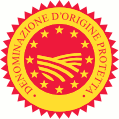
PDO, acronym for Protected Designation of Origin, is a legal protection mark granted by the European Union to foods whose particular qualitative characteristics depend essentially or exclusively on the territory in which they are produced. A territory that includes both natural factors (environmental characteristics) and human factors (production techniques handed down over time) which, combined together, make it possible to obtain a product that cannot be imitated outside a specific production area. For a product to be PDO, the stages of production, processing, and preparation must take place in a defined geographical area. Those who produce PDO products must comply with the strict production rules established in the production specification. Compliance with these rules is guaranteed by a specific control body. To visually distinguish PDO products, a specific mark has been created whose distinctive colors are yellow and red. In Italy, the currently recognized PDO products are 168 (update as of August 26, 2019). Sardinia has obtained PDO recognition for only 6 products: At the Italian level, we are at the bottom of the regional ranking for the number of excellences recognized by the European Community.
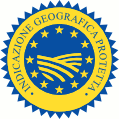
The term PGI, acronym for Protected Geographical Indication, indicates a designation of origin that is granted by the European Union to those agricultural and food products for which a specific quality, reputation, or other characteristic depends on the geographical origin, and whose production, processing and/or preparation takes place in a specific geographical area. To obtain the PGI, therefore, at least one stage of the production process must take place in a particular area. Those who produce PGI products must comply with the strict production rules established in the production specification, and compliance with these rules is guaranteed by a specific control body. It differs from the more prestigious Protected Designation of Origin (PDO), in that it is generally a more permissive label regarding only the origin of the raw materials (which, if provided for by the individual specifications, may be of national, EU, or sometimes even non-EU origin), as it protects the recipes and some typical production processes characteristic of the place but not necessarily the origin of the product as a whole, except for the final production. This is sometimes allowed mainly because local or national production of raw materials intended for this purpose may not be sufficient to meet the global demand for the product, or because some foreign ingredients are considered more suitable due to their specific organoleptic characteristics, which play a decisive role in the final outcome of the product. To visually distinguish PGI products, a specific logo has been created, whose distinctive colors are yellow and blue. In Italy, there are currently 129 recognized PGI products (as of August 26, 2019). Sardinia has obtained PGI recognition for only 2 products:
You can find the updated list of PDO, PGI, and TSG products on the website of the
The PAT, acronym for traditional agri-food products, are products included in a specific list, established by the Ministry of Agricultural, Food, Forestry and Tourism Policies (Mipaaft) with the collaboration of the Regions. In order to be included in the list, we must be dealing with typical products traditionally processed for at least 25 years, and documented by historical records and interviews. The annual update and publication of the list is managed by the Ministry, which is also responsible for promoting awareness of it nationally and abroad. To date, there are 5,128 PAT products in Italy, while in Sardinia there are more than 200. They are often the first step towards subsequent recognition as a PGI or PDO. Examples of PAT from Sardinia are Abbamele, kid rennet, asphodel honey, and sa casada. The updated list of PAT in Sardinia is available in a special section of the region's website.
The term TSG or Traditional Speciality Guaranteed, is a designation of origin introduced by the European Union aimed at protecting specific products characterized by traditional compositions or production methods. This type of protection is aimed at agricultural and food products that have a "specific" production or composition (that is, different from other similar products) and "traditional" (that is, existing for at least twenty years), even if they are not necessarily produced only in that area. The TSG product can be prepared in any country of the European Union, provided that the production complies with the relevant specification and is certified by an accredited control body. In Italy, the currently recognized TSG products are only 2 (as of August 26, 2019), namely Mozzarella and Neapolitan Pizza.
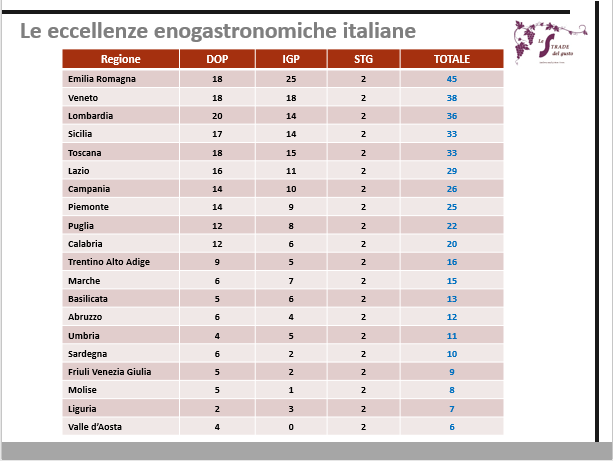
Slow Food Presidia support small traditional productions that risk disappearing, enhance territories, recover ancient crafts and processing techniques, and save native breeds and varieties of vegetables and fruit from extinction. Today, over 500 Slow Food Presidia (of which 250 are Italian) involve more than 13,000 producers. A presidium protects a traditional product at risk of extinction; a traditional technique at risk of extinction (of fishing, breeding, processing, cultivation); a rural landscape or ecosystem at risk of extinction. In Sardinia, 21 types of cheese, 4 types of cured meats, 5 types of pasta, 11 types of bread, and 22 types of sweets have been recognized as Slow Food presidia. The table below shows in numerical quantities the DOP, IGT, and STG recognized for each Italian region. Some are shared between several regions.
It is clear that Sardinia is still very far from having achieved a satisfactory number of recognitions. There is certainly no shortage of excellence in the region, but so far there have been few actions to promote them. And the promotion of Sardinia as a food and wine tourism destination definitely also passes through this type of recognition.
.png "10 cibi sardi da assaggiare assolutamente a Cagliari")
.png "10 Sardinian Foods You Must Try in Cagliari")
.jpeg "San Benedetto Market Cagliari: The Complete Guide to Sardinia's Most Authentic Food Experience (2026)")