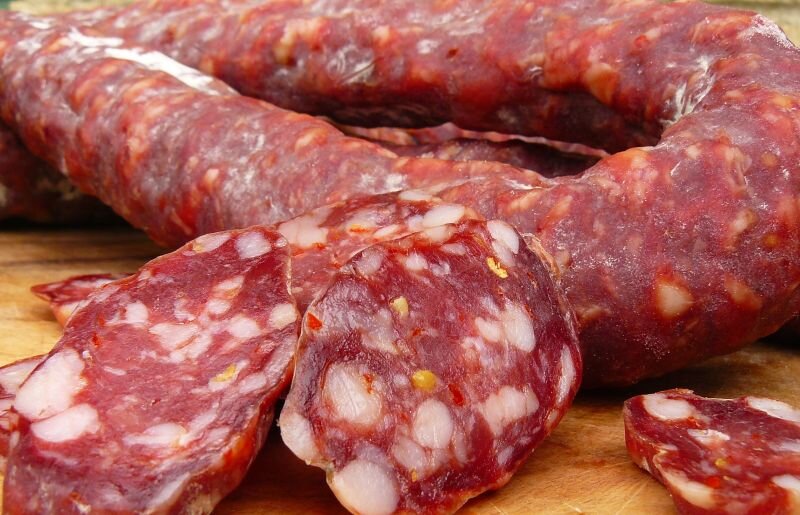
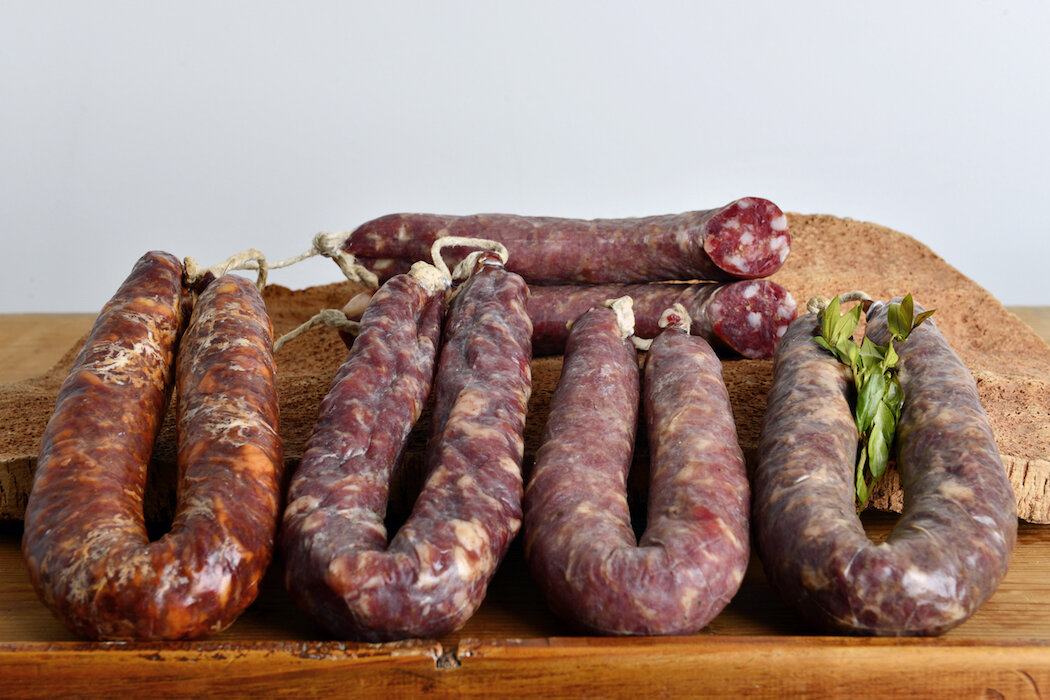
On October 19 and 20, I will have the pleasure of participating in the celebrations for the twentieth anniversary of ONAS (National Organization of Cured Meats Tasters), an association I have only been a part of for a few months (as a cured meats tasting technician) but which has already given me so much in terms of training and tasting experiences. During the celebrations, several social activities are planned, including the pairing of cured meats with craft beers, an event that will take place at a famous brewery in Piedmont. But this experience will be told in due time. Actually, with this article I would like to address the topic of tasting and recognizing quality cured meats and in particular the queen of Sardinian charcuterie, namely sausage. Sardinian sausage, also called sartizzu, is considered the Sardinian cured meat par excellence, produced throughout the Sardinian territory and has the typical horseshoe shape. This product has very ancient traditions and can be sold fresh, aged, and smoked. The lean meats, combined with lard from large pigs (unfortunately not always of Sardinian breed due to the long-standing problem, now being resolved, of "swine fever"), are cut by hand into fairly large pieces, seasoned with salt, pepper, fennel, natural aromas, and stuffed into natural casings washed with vinegar and wine. It is tied in coils of 40-50 cm bent into a horseshoe shape which, at the end of the 30/40 day aging period, have an average weight of 400 g and a diameter of about 3.5 cm. It can be smoked with aromatic woods (for example with myrtle). But what are the elements that allow us to distinguish a good product from a mediocre one when shopping at the delicatessen? First of all, you need to examine the external appearance of the cured meat, as much as possible, even though this operation is difficult if the cured meat is vacuum-packed. Usually, positive aspects are the tying with string (which usually indicates a sausage produced artisanally) and a moderately firm consistency to the touch, indicating a correct aging period (so the sausage should not be soft, as in that case it is sold prematurely). If you have the chance to taste before buying, you should examine the appearance of the slice.
Among the positive aspects, we should have the color of the meat ranging from bright red to moderately dark red; the color of the lardons (which must be evenly distributed) should be white or white/pink; there should be no holes and the "peelability" (that is, the ease of removing the casing that encloses the sausage) should be good. The slice as a whole should appear whole and compact, but with the right melt-in-the-mouth quality. An important and often underestimated part in choosing a good product is the evaluation of the aromas and their intensity. This analysis will not be possible in the case of cured meats purchased in trays or vacuum-packed. Positive aspects are the smell of aged meat and spices, which, however, must be used in a balanced way to enhance and not cover the aroma of the meat. In Sardinian sausage, the most intense aromas you will perceive are those of garlic, pepper, fennel seeds or wild fennel, and in some cases wine. Once the visual and olfactory analysis is complete (all of which takes place in a few seconds), you can move on to tasting the delicious cured meat. In this phase, attention should be paid to both taste and structure and chewability. Sardinian sausage should not have an acidic or bitter tendency, but should definitely have a savory (not salty) flavor that can be more or less intense depending on the area of origin and the recipe used. In the mouth, the slice should not be dry or hard, pasty or excessively melt-in-the-mouth, but should be chewed and swallowed easily. Therefore, a reduced presence of gristle or tendons is desirable (these are what make chewing difficult and cause that annoying residue effect between the teeth). Another important and not negligible detail in choosing a sausage, especially if you intend to export it outside Sardinia to perhaps give it as a gift to friends and relatives, is the presence of a stamp on the package (always check for it): OVAL STAMP: in this case the product can be taken outside Sardinia as it is a sausage produced with meat not from Sardinian farms and slaughtered in authorized slaughterhouses. RECTANGULAR STAMP: the product cannot be taken outside Sardinia and can only be consumed within the regional territory as it is produced with Sardinian meat and slaughtered in authorized slaughterhouses.
.png "10 cibi sardi da assaggiare assolutamente a Cagliari")
.png "10 Sardinian Foods You Must Try in Cagliari")
.jpeg "San Benedetto Market Cagliari: The Complete Guide to Sardinia's Most Authentic Food Experience (2026)")